


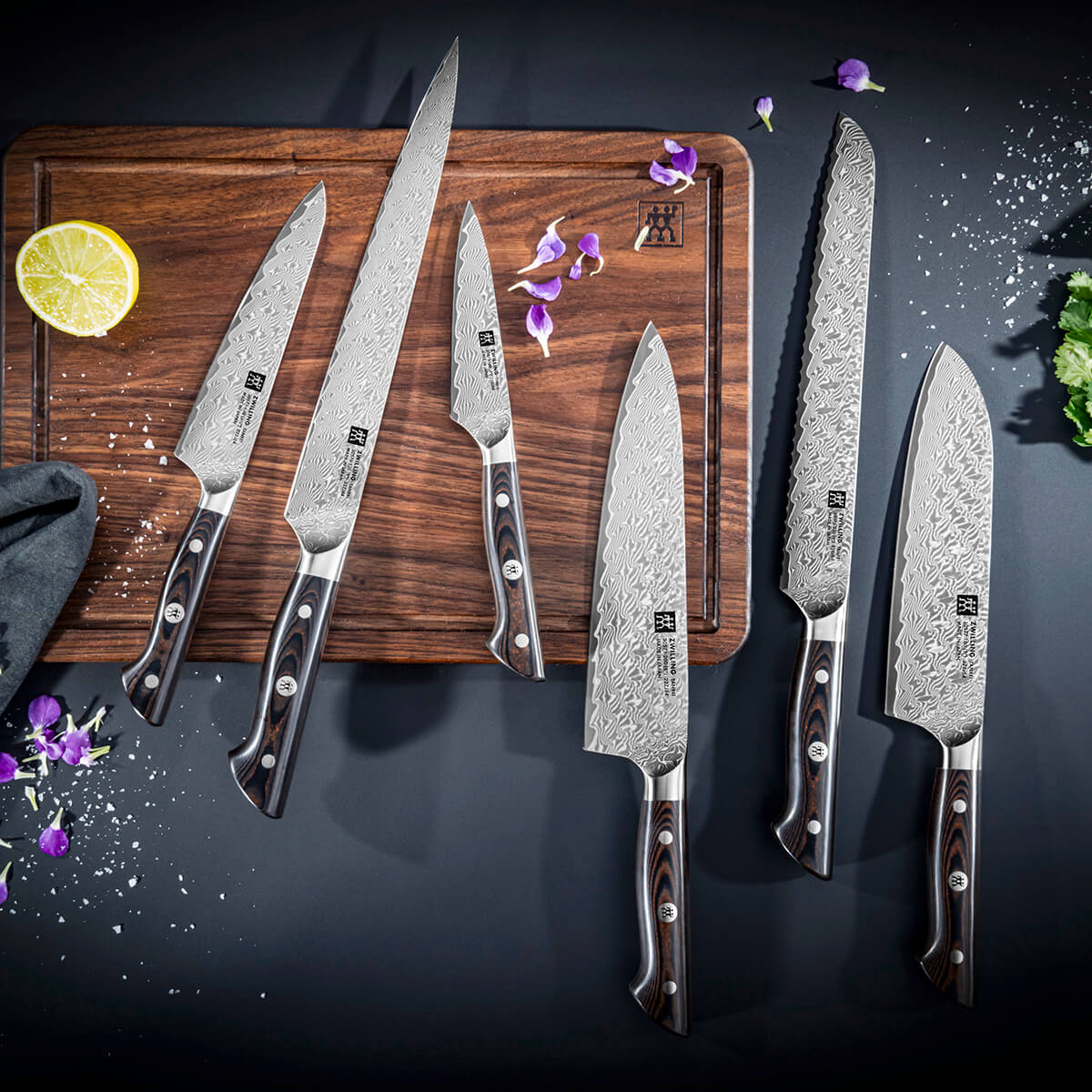
Having the right Kitchen Knives can make a big difference to your experience in the kitchen. Cutting with a sharp knife is a pleasure, and when you use a knife designed for the job, it can be a bit of an aha experience.
Here's a guide to which Kitchen Knives you should choose and in what order, if you ask us:
1. Chef's knife (Gyutoh)
2. Santoku knife
3. Vegetable knife (Shotoh)
4. Bread knife
5. Filleting knife / Carving knife (Sujihiki)
6. Chutoh knife
Let's elaborate on this order in the following.
Which Kitchen Knives should I get and where should I start?

1. Chef's knife (Gyutoh)
The chef's knife, also known as gyutoh in Japanese, is the most important and versatile tool in the kitchen. It's a true all-purpose knife that can easily cut, slice and chop meat, vegetables, fruit and fish.
Thanks to its balanced shape, pointed tip and long cutting edge, the chef's knife makes it easy to work quickly and precisely - whether you're finely chopping onions, slicing meat or cutting larger ingredients. That's why it's also the knife most professional chefs and enthusiasts reach for first.
If you only have to choose one knife for your kitchen, the chef's knife is the obvious choice. It covers the vast majority of tasks and gives you control, efficiency and comfort in your work.
We recommend a chef's knife between 16 and 26 cm, depending on your experience, hand size and personal preference. Shorter knives offer more control and are often preferred by beginners, while longer knives are faster and more efficient for larger ingredients and more experienced users.

2. Santoku knife
The Santoku knife is similar to a classic chef's knife, but has a shorter, wider and flatter blade. This gives a very stable and controlled cutting feel, especially when working with vegetables.
The name Santoku means "three virtues" in Japanese and refers to the knife's three primary functions: cutting, chopping and slicing - across meat, fish and vegetables. It is particularly strong for precision work and fast chopping, where the flat blade makes it easy to work efficiently on the cutting board.
The Santoku knife is an excellent complement to the chef's knife and fits perfectly as your #2 knife. While the chef's knife is the most versatile workhorse, the Santoku gives you extra control and comfort for more detailed tasks in the kitchen.

3. Vegetable knife (Shotoh)
The vegetable knife, also known as Shotoh in Japanese, is a small and lightweight knife designed for precision work. It's ideal for peeling, trimming and cutting fruits and vegetables where control and accuracy are more important than raw power.
Thanks to its short blade and light weight, the Shotoh knife gives you a very direct feel for the raw material, making it perfect for fine tasks like peeling and slicing garlic, cleaning mushrooms, removing seeds or making small, detailed cuts. It's also indispensable for decorative work and tasks where a large knife would be impractical.
Where the chef's knife and Santoku handle the big jobs, the Shotoh knife is your preferred tool for the details - the small precision knife that completes your knife set.

4. Bread knife
The bread knife is equipped with a serrated blade designed to cut through crispy crusts and soft crumbs without squashing or fraying the bread. Instead of pressing through the raw material, the teeth "bite" through the surface for clean cuts - even in freshly baked, fluffy bread.
A staple in any well-equipped kitchen, it is far more versatile than many people think. The bread knife is also excellent for soft or smooth foods like tomatoes, citrus fruits, cakes and soft fruits, where a regular blade will often slip or flatten the food.
In short, the bread knife is your specialist when the raw material has a hard outside and a soft inside - and therefore an indispensable complement to the smooth Kitchen Knives.

5. Filleting knife / Carving knife (Sujihiki)
The filleting knife is a long, narrow and flexible knife designed to follow the natural shape of the raw material. It is particularly suitable for filleting fish, but also for trimming and cutting delicate cuts such as chicken breasts, fish fillets and tender steaks.
The flexible blade allows you to work close to bones, skin and tendons, so you can separate the meat with great precision. This means you get a neater result while making the best use of the raw material - with less waste and more meat on the plate.
Where other knives cut through the raw material, the filleting knife works with it, making it indispensable for anyone who wants clean cuts and maximum yield from fish and meat.

6. Chutoh knife
The Chutoh knife is a medium-sized Japanese knife with a shorter blade and a relatively flat profile, providing a high degree of control and stability while working. It is ideal for precise cuts, trimming and light filleting where accuracy is more important than power.
The sharp and finely honed blade glides easily through both meat and fish, making it easy to work close to the raw material without tearing or damaging the structure. This makes the Chutoh knife particularly suitable for tasks where you want clean, smooth cuts and a professional result.
Where larger blades provide reach and speed, the Chutoh gives you control and finesse - perfect for the more demanding and detailed tasks in the kitchen.
Please note
It's important to keep in mind that these are just guidelines and not hard and fast rules. Choosing Kitchen Knives depends on your personal preferences, what you've used before and what you can handle size-wise.
One thing is for sure; if you buy good knives and take care of them and maintain them regularly, you will have them for many years to come! Once you've tried using good (and sharp) knives, you'll never look back!
See our Kitchen Knives here:

Choose your option

Choose your option

Choose your option

Choose your option

Choose your option

Choose your option


Choose your option

Choose your option



Author: Finn Brose


