


A while ago, I received an email with the subject line: "Want to test a Razorpit?". Many thoughts went through my head, most of which were probably best associated with a horror movie.
Having only heard of Razorpit in the context of cassette scrapers, it was understandable that I thought this was a test of Razorpit in the context of a cassette scraper, and the barber snob in me had only one resounding answer to that question: "No thanks!".
However, I was somewhat surprised when I opened the email and the question turned out to be different, namely whether you could use a Razorpit in combination with a Safety Razor? After brief consideration, I thought it sounded really interesting, so I accepted the "challenge" and agreed to test the Razorpit with a Safety Razor.
It was with some curiosity that I received the Razorpit, unpacked it, examined it and read the instruction manual - the latter is something I normally only do if all else fails, but in this case I thought it was appropriate to do so. There's no big hocus-pocus in it; a rubber plate that needs to be lubricated with foam, after which the (cassette) Razor is pushed over the plate 4 times, rinsed and put in place.
I'll be honest and admit that I've seen the Razorpit more as a publicity stunt than as something that actually works as described. Sure, it's designed with the cartridge shaver in mind, but the claim that you can get "up to 150 shaves" with the same blade sounds too good to be true, and "up to" can mean anything from 10 to 150, and if you only get ten, then the investment doesn't match the return in my opinion.
To minimize the number of variables, I chose to use the same Razor and the same blade brand throughout the experiment.
Products used:
Razor
The Razor I chose to use for the experiment was a Gillette Fat Handled Tech (1938-1942), and it was chosen for two reasons:
1. It's my absolute favorite Razor, and if I was going to be in the company of the same Razor for a long time, it had to be a good one and one I didn't get tired of.
2. It's a gentle Razor that gives really good feedback, and that was not unimportant in an experiment like this.
Razor Blade
I chose to use Derby Extra magazine for the experiment as it is an easily accessible, popular and good all-round magazine.
All the leaves used in the experiment came from the same package, again to make any variations as small as possible.
The experiment
So finally, with some biased skepticism, I went ahead and to make this as comparable and fair as possible, I started with a control. The control consisted of a fresh Derby Extra blade that I shaved with until it felt worn. The blade was not removed from the Razor after shaving, the Razor was just rinsed under the hot tap and then put back in place.
All shaves throughout the experiment have been on four passes; WTG, WTG, XTG and ATG.
With my control, I achieved 36 shaves before the blade wore out. It was a surprising number, I had expected somewhere between five and ten myself, but at least now I had a starting point.
After the check, a new blade was inserted into the Razor and the shaving process repeated, with the only difference being that after shaving, the Razor head was pushed over the Razor pith four times for each side, rinsed in warm water and put back in place.
It takes a little practice to get the blade to actually make contact with the rubber, the safety bar and the curvature of the scraper head can make it a little difficult, as the Razorpit is designed for a cassette scraper that is completely flat.
I think it has been difficult to set a success criterion for something you don't know what to expect, but in my eyes it would be if I could achieve a minimum 25% improvement with Razorpitten than without, and since I got 36 shaves in my control, I would have to hit 45 to be able to say that there was an improvement.
Up to about 30 shaves, the feeling was as normal, although you could feel that the blade wasn't brand new anymore. When I reached around 40 shaves, it felt like the blade was starting to wear out and I was expecting it to come off pretty quickly, but around the 45th - 46th shave, I was surprised to get a completely comfortable BBS.
This led me to analyze the last few shaves and I came to the conclusion that the lather in the previous shaves hadn't been "spot on", which then gave the feeling of a worn blade. The next few shaves I paid close attention to getting the lather as perfect as possible, which resulted in close, comfortable and trouble-free shaves.
When I reached around 60 shaves, my surprise was actually palpable, I almost thought it was a lie, but when I plotted all the shaves in a spreadsheet since the start of the challenge, there was nothing wrong, the numbers spoke for themselves.
By the time I reached about 80 shaves, I could clearly feel that the blade wasn't super sharp anymore, it didn't shave quite as close, but it still wasn't uncomfortable by any means, and I found that by using "The Gillette Glide" technique, I could still achieve minimum DFS every time, and when I used a soap with a really good glide and got a perfect lather, BBS was also just about achievable (including touch-ups).
When I got to around 90-92 shaves, under normal circumstances I probably would have scrapped the blade because it felt quite tired. It took a lot of touch-up work to get a close shave and I could tell the blade was wearing out, but now I was so close to 100, I thought it would be kind of fun to see if that number could be reached - without making it uncomfortable in any way, it just took more work.
I barely managed 100 shaves but then the blade was finished and I have to say that it almost deserves to be displayed in a showcase because 100 shaves with the same blade is pretty impressive.
I finished the experiment with another control shave, this time rinsing the Razor in cold water after use. With this control, I got 23 shaves.
Conclusion
There's not much more to say. The test shows in all its clarity that you can extend blade life significantly - I got an improvement of 64 and 77 shaves or expressed as a percentage; an improvement of 178% and 334% respectively.
Of course, the test result should be taken with the caveat that another person will most likely come to a different conclusion when it comes to the number of shaves. Some may get fewer shaves and some may get more than I did, but I feel completely confident that whoever tries Razorpitten will be able to extend the life of a DE blade compared to normal use.
Whether Razorpitten is worth the investment (money + time), I will leave it up to the individual to decide.
I've read a theory that says the blade lasts longer in a mild Razor than in an aggressive Razor. I never really wondered if it could be true, but with this experiment behind me, it would be fun to choose an aggressive Razor (open comb) and repeat the experiment with it. Since the blade is more exposed in an open Razor, it should be a little easier to use on the Razorite, and all else being equal, it should be equally obvious if the theory holds true.
In addition to the Razorite, I had an interesting discovery that the control shaves also show with some clarity that rinsing a blade in hot water makes it last longer than rinsing it in cold water.
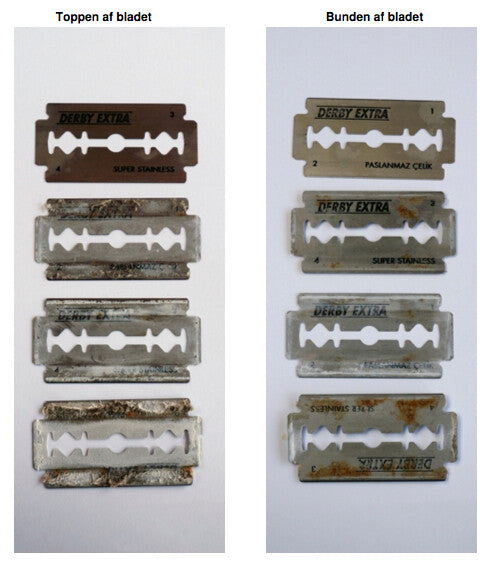
Photos of the blades support that claim, as it's pretty clear that lather and hair residue builds up faster on the blade rinsed in cold water compared to the blade rinsed in hot water. And when you take a look at the blade that lasted for 100 shaves, it's almost surprising that it could still shave.
Before

Anus

Before
Anus

Before
Anus


